The Zero-Trust Legal Perimeter: Securing AI in the Most Sensitive Industry on Earth
Law firms are prime targets for cyberattacks. How Vigil utilizes Zero-Knowledge architectures to protect privileged client data while delivering superhuman analytical capabilities.

The Ultimate Honeypot
Law firms hold the most sensitive data on the planet: unannounced M&A deals worth billions, unfiled patent applications that represent years of R&D investment, confidential litigation strategies that could move stock prices, and privileged communications that are constitutionally protected from disclosure. This makes them the ultimate honeypot for state-sponsored hackers, corporate espionage operations, and ransomware syndicates.
The statistics are alarming. According to the American Bar Association's 2025 Legal Technology Survey, 29% of law firms reported a security breach in the past year. The average cost of a data breach in the legal sector exceeds $5.4 million, but the reputational damage—the loss of client trust—is incalculable and often fatal to the firm.
When deploying AI into this environment, the security stakes are not merely elevated—they are existential. You cannot paste a client's unannounced merger term sheet into ChatGPT. You cannot upload privileged litigation strategy documents to a multi-tenant LLM API where your data might be used to train models that serve your opposing counsel. The attorney-client privilege, the work product doctrine, and the duty of confidentiality are not merely ethical obligations—they are the foundation upon which the entire legal system is built.
Vigil's Zero-Knowledge Architecture
At BasaltHQ, we designed Vigil with a Zero-Trust, Zero-Knowledge architecture from the ground up. This is not a bolt-on security layer added after the product was built. It is the foundational design principle that informed every architectural decision.
1. Tenant Isolation and Dedicated Vector Infrastructure
Every Vigil instance operates within a strict privacy perimeter that is mathematically isolated from every other tenant. When documents are ingested, they are converted into cryptographic vector embeddings using tenant-specific encryption keys. These embeddings are stored in dedicated vector indices that are physically separated at the infrastructure level—not merely logically partitioned within a shared database.
The critical property of this architecture is irreversibility. The vector embeddings cannot be reverse-engineered to reconstruct the original document text without the tenant-specific decryption key. Even if an attacker gained access to the raw vector storage, they would possess nothing but meaningless arrays of floating-point numbers.
We do not pool client data. We do not use client data for model training. We do not retain client data beyond the tenant-specified retention period. Your intelligence remains yours, absolutely and irrevocably.
2. Autonomous Context Masking
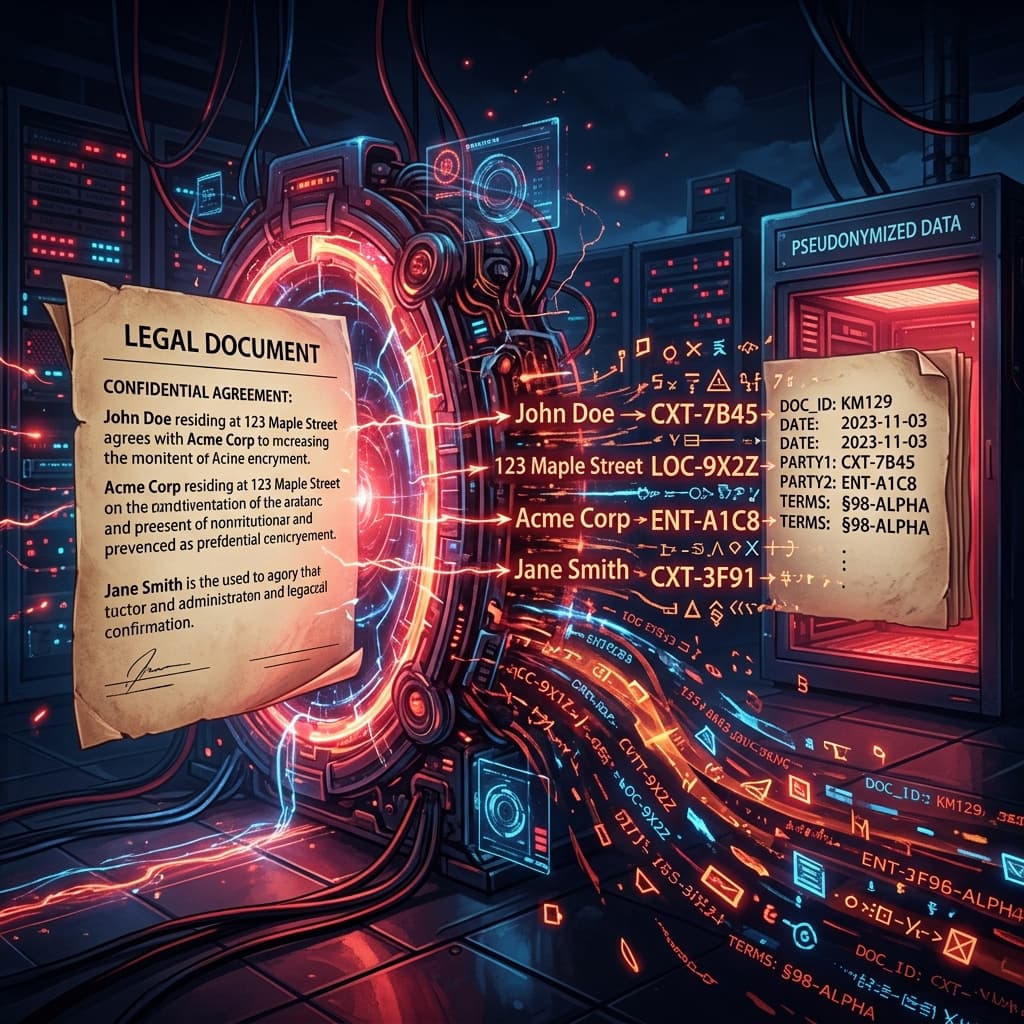
When a Vigil agent needs to utilize a larger foundational model for complex reasoning tasks that exceed the capabilities of our locally deployed models, it employs Autonomous Context Masking—a sophisticated pseudonymization pipeline that operates in real-time.
If the agent is reviewing an NDA between "Apple" and "Google" regarding a potential acquisition of "Waymo," the context masking layer autonomously:
- Identifies all named entities (companies, individuals, products, monetary amounts, dates, addresses)
- Generates semantically neutral pseudonyms ("Company A," "Person 1," "$VALUE_X")
- Maintains a secure mapping table that never leaves the tenant perimeter
- Sends only the masked prompt to the external model
- Receives the reasoning output and re-injects the real entities within the secure enclave
The external model never sees a single real name, dollar amount, or identifying detail. It performs its reasoning on sanitized data and returns sanitized results. The reconstruction happens exclusively within your encrypted perimeter.
3. On-Premise Swarm Deployment
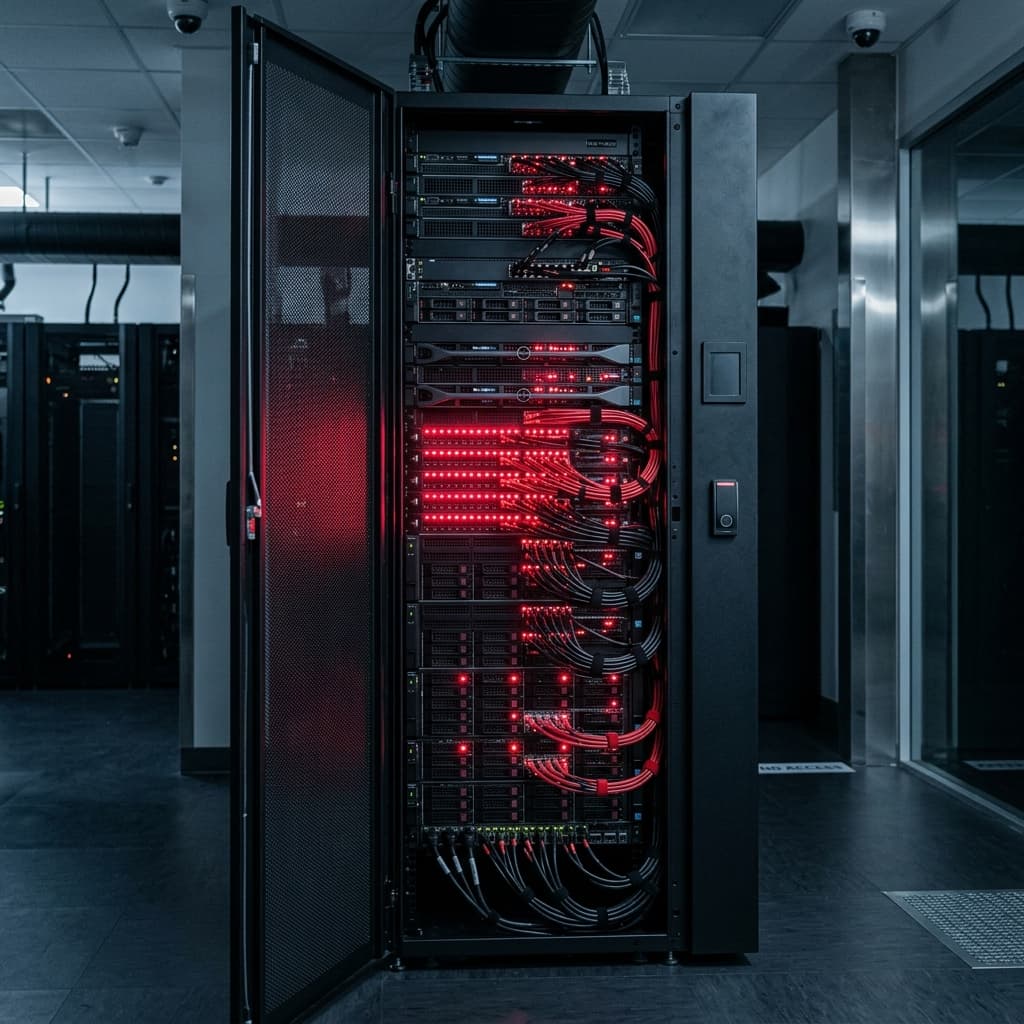
For our highest-tier law firm and defense clients—those handling matters of national security, ITAR-controlled technology, or cases with nine-figure exposure—we bypass external APIs entirely. Vigil can deploy heavily quantized, highly capable LLM swarms directly onto your firm's bare-metal servers or private Virtual Private Cloud (VPC).
In this configuration:
- Zero network egress: No data, no prompts, no embeddings ever leave your physical infrastructure
- Air-gapped operation: The system can operate without any internet connectivity whatsoever
- Hardware security modules (HSM): Encryption keys are stored in tamper-resistant hardware, not software
- Audit logging: Every agent action, every document access, every inference call is logged to an immutable, append-only audit store
The AI never phones home. It operates as a self-contained intelligence system within your existing security perimeter, subject to your existing access controls, your existing monitoring tools, and your existing compliance frameworks.
Compliance and Certification
Vigil's security architecture is not merely aspirational—it is independently verified. Our infrastructure maintains:
- SOC 2 Type II certification, with annual audits by a Big Four accounting firm
- ISO 27001 certification for our information security management system
- HIPAA BAA availability for healthcare-adjacent legal work
- FedRAMP authorization in progress for federal government engagements
Attorney-client privilege is sacrosanct. With Vigil, you gain superhuman analytical capabilities without compromising a single byte of confidentiality. That is not a marketing claim—it is an architectural guarantee.