Beyond CLM: The Agentic Contract Enforcement Engine
Traditional CLMs are just expensive filing cabinets. Discover how Vigil actively negotiates, redlines, and enforces contracts autonomously throughout their entire lifecycle.

The Passive Filing Cabinet
The previous generation of Contract Lifecycle Management (CLM) software made a fatal mistake: it assumed the primary problem was storage and retrieval. CLMs became expensive, glorified filing cabinets with a clunky search bar and a workflow engine that required months of configuration to handle even basic approval routing. They required humans to manually input metadata, track renewal dates, identify risk clauses, and execute the actual legal reasoning that makes contract management meaningful.
The global CLM market is valued at approximately $2.1 billion. Enterprises spend an average of $150,000 to $500,000 annually on CLM software licenses alone, plus another $200,000 to $1 million on implementation, customization, and training. And after all that investment, the fundamental workflow remains unchanged: a human still has to read every contract, understand every clause, and make every decision.
Vigil is not a CLM. It is an Agentic Negotiation and Enforcement Engine that transforms static legal documents into executable intelligence.

Autonomous Redlining
When a counterparty sends a 40-page Master Services Agreement (MSA) in Microsoft Word, you do not need to read it. You do not need to assign it to a junior associate. You drag it into Vigil.
Within seconds, the swarm decomposes the document into its constituent clauses, classifies each clause by type (indemnification, limitation of liability, intellectual property assignment, confidentiality, termination, governing law, dispute resolution, force majeure), and compares every clause against your company's predefined risk playbook.
The system doesn't merely flag deviations. It takes action:
-
Liability cap at $5M instead of your standard $1M? Vigil strikes the counterparty's language, inserts your preferred cap with a carve-out for IP indemnification and willful misconduct, and adds a margin comment explaining: "Reduced to $1M aggregate cap per Company playbook §4.2. Carve-outs for IP and willful misconduct retained per industry standard."
-
Non-standard auto-renewal clause with 90-day notice? Vigil replaces it with your preferred 30-day notice provision and adds: "Modified to 30-day notice period per Company playbook §7.1. 90-day notice is operationally burdensome and creates lock-in risk."
-
Missing GDPR compliance language in the data handling section? Vigil inserts a complete Data Processing Addendum based on the Standard Contractual Clauses, pre-populated with your company's technical and organizational measures, and adds: "DPA inserted per Company playbook §9.3. Required under GDPR Art. 28 for any processor handling EU personal data."
The output is a heavily redlined Microsoft Word document, formatted exactly as your attorneys expect, ready for human review. The review time drops from 4-6 hours to 15-20 minutes, because the attorney is now reviewing decisions rather than making them from scratch.
The Active Enforcer
A contract's lifecycle doesn't end at signature. In legacy CLM systems, signed contracts gather dust in a repository until a dispute arises and someone desperately searches for the relevant clause. By then, the damage is done.
Vigil transforms signed contracts from static PDFs into executable code. Every obligation, every deadline, every performance metric in a signed contract is extracted, structured, and connected to real-time data streams.
SLA Enforcement
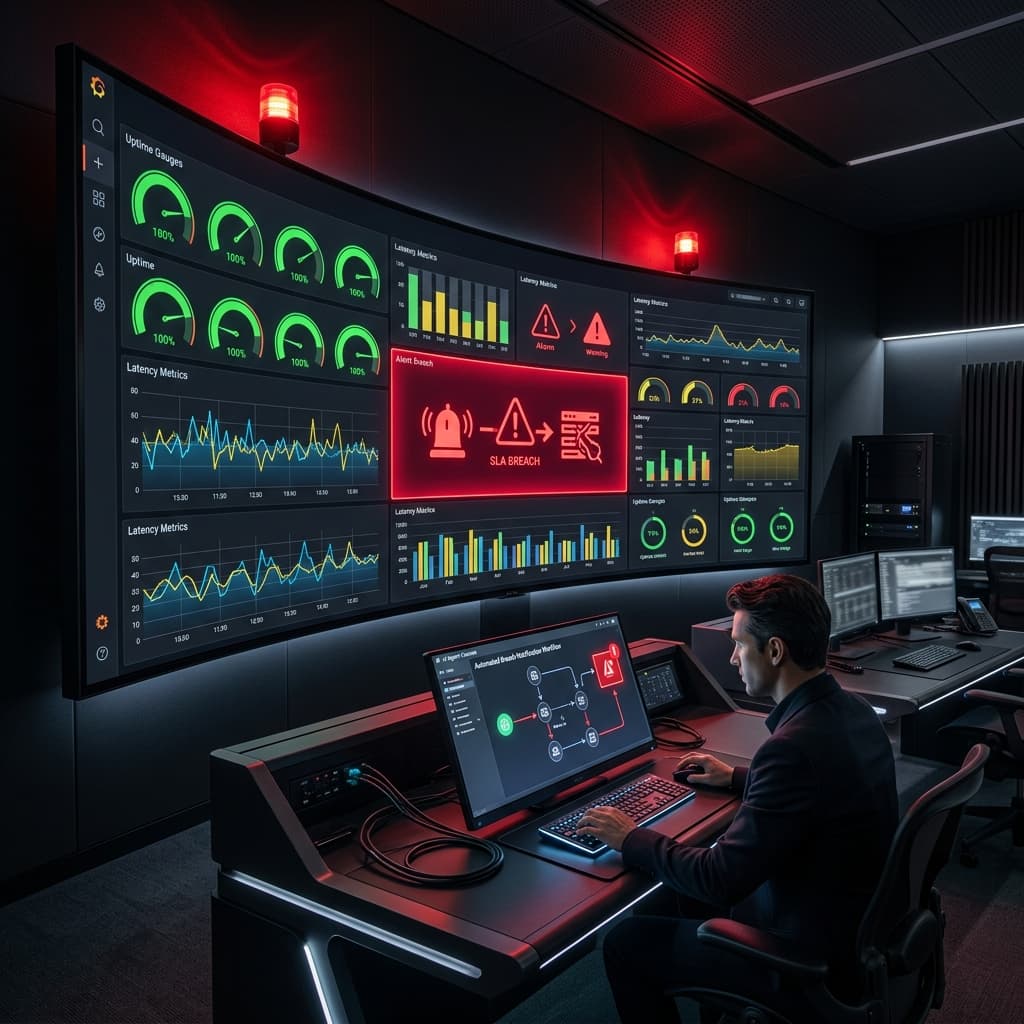
If a Service Level Agreement stipulates that a vendor owes a 5% credit if uptime drops below 99.9%, Vigil actively monitors the vendor's uptime telemetry. The moment the SLA threshold is breached, Vigil:
- Calculates the exact credit amount based on the contractual formula
- Generates a formal breach notification letter citing the specific clause, the measured uptime percentage, and the calculated credit
- Attaches the supporting telemetry data as an exhibit
- Stages the notification for your General Counsel's one-click approval
- Tracks the vendor's response and escalates if the credit is not issued within the contractually specified cure period
Renewal Management
Vigil doesn't just remind you that a contract is expiring. Sixty days before a renewal deadline, it:
- Analyzes the vendor's performance over the contract term
- Benchmarks pricing against current market rates
- Identifies any terms that should be renegotiated based on changes in your company's risk posture or regulatory environment
- Drafts a renewal proposal with suggested amendments
- If auto-renewal is not desired, generates and sends the required notice of non-renewal within the contractually specified notice period

The ROI of Active Enforcement
The financial impact of active contract enforcement is substantial and measurable:
-
Revenue recovery: The average enterprise has $1.2 million in uncollected SLA credits and contractual penalties sitting in their contract portfolio. Vigil identifies and pursues these credits automatically.
-
Cost avoidance: Missed renewal deadlines cost enterprises an average of $600,000 annually in unwanted auto-renewals. Vigil eliminates this entirely.
-
Risk reduction: Unmonitored compliance obligations create an average contingent liability of $3.4 million per Fortune 500 company. Vigil converts these from hidden risks to actively managed obligations.
Contracts are meant to govern behavior. Vigil ensures that governance is executed flawlessly, at machine speed, with mathematical certainty. The era of the passive filing cabinet is over.