Swarm Intelligence in Mergers and Acquisitions: Due Diligence at Machine Speed
Due diligence used to take months and cost millions. With Vigil, thousands of AI agents can review millions of documents overnight, identifying risks with mathematical certainty.

The Data Room Bottleneck
In any Merger or Acquisition, the critical bottleneck is due diligence. The target company uploads a virtual data room containing tens of thousands of documents: employment contracts, IP assignments, vendor agreements, financial ledgers, environmental reports, and regulatory filings. The volume is staggering—a typical mid-market acquisition involves 30,000 to 80,000 documents. Large-cap deals can exceed 500,000.
The acquiring firm then assigns a team of 15 to 40 junior associates to spend six to twelve weeks reading these documents, desperately searching for change-of-control provisions, non-compete violations, pending litigation risks, environmental liabilities, and tax exposure. It is expensive—often costing $2 million to $5 million in legal fees alone—slow, and catastrophically prone to human error caused by exhaustion, information overload, and the cognitive limitations of reading thousands of pages of dense legal text under extreme time pressure.
The consequences of missed issues are severe. A 2024 study by McKinsey found that 40% of post-acquisition value destruction is attributable to risks that were identifiable in the data room but were missed during due diligence. That represents billions of dollars in preventable losses annually.

Enter the Swarm
BasaltVigil applies Swarm Intelligence to the M&A data room. This is not a single AI model scanning documents sequentially. It is a coordinated deployment of thousands of micro-agents, each with a specific mandate, operating in parallel across the entire document corpus.
The Specialized Swarm Architecture
-
The IP Swarm: A cluster of 200+ agents searches exclusively for chain-of-title defects in patent assignments, identifies patents that are co-owned with third parties (creating blocking rights), flags any IP that was developed under government funding (triggering march-in rights under Bayh-Dole), and verifies that all inventor assignments are properly executed and recorded.
-
The Employment Swarm: Analyzes every employee contract, executive compensation agreement, and benefit plan document. It identifies golden parachute clauses triggered by change of control, calculates the aggregate cost of severance obligations, flags non-compete agreements that may be unenforceable in specific jurisdictions, and identifies key-person dependencies where critical knowledge is concentrated in a single employee with no non-compete protection.
-
The Commercial Swarm: Reviews every vendor, customer, and partner agreement. It flags any contract that contains a termination-for-convenience clause triggered by a change of control, identifies contracts with most-favored-nation pricing provisions that could be disrupted by the acquisition, and calculates the aggregate cost of consent fees required to assign contracts to the acquiring entity.
-
The Tax Swarm: Analyzes the target's tax positions across all jurisdictions, identifies potential transfer pricing exposures, flags uncertain tax positions that may require reserves, and models the tax implications of different deal structures (asset purchase vs. stock purchase vs. merger).
-
The Litigation Swarm: Searches for undisclosed litigation risks by cross-referencing the target's entity names against public court dockets, identifies contractual indemnification obligations that could create contingent liabilities, and flags any arbitration clauses that might affect the buyer's ability to pursue post-closing claims.
Because these agents operate in parallel across a distributed compute infrastructure, a data room containing 50,000 documents can be fully processed, analyzed, cross-referenced, and summarized in under four hours. A 500,000-document large-cap data room takes approximately 18 hours.
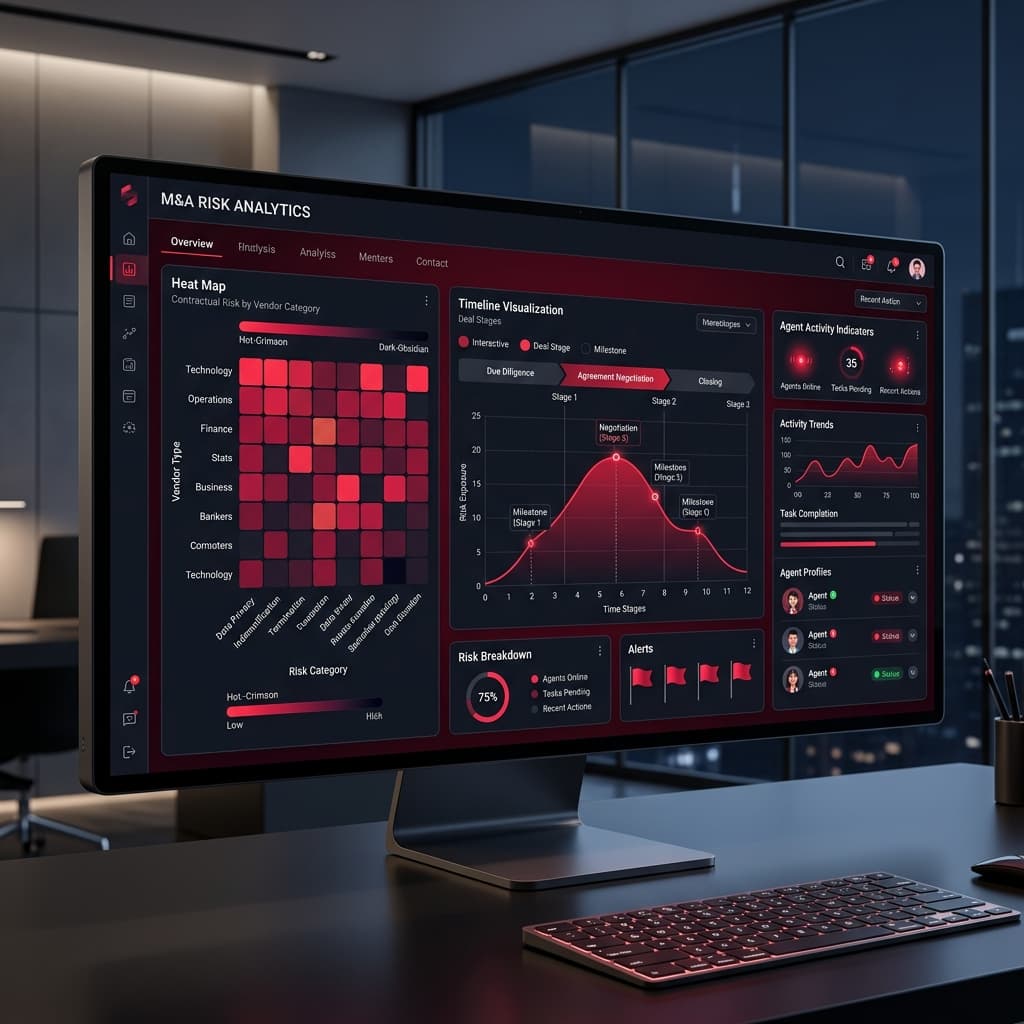
The Interactive Diligence Dashboard
The output is not a static 500-page memo that takes a week to read. It is an interactive, real-time intelligence dashboard. The lead M&A partner can query the system conversationally:
"Show me all vendor contracts exceeding $50k annually that require consent for assignment."
Vigil instantly surfaces the exact contracts, highlights the relevant clauses, calculates the aggregate consent cost, identifies which vendors are likely to withhold consent based on historical behavior patterns, and autonomously drafts the required consent waiver letters—ready for signature.
"What is our total severance exposure if we terminate all C-level executives within 12 months?"
Vigil cross-references every executive employment agreement, calculates base salary multiples, bonus targets, equity acceleration provisions, COBRA continuation costs, and any tail provisions in D&O insurance policies, producing a precise dollar figure within seconds.

The Strategic Advantage of Speed
By compressing the due diligence timeline from months to hours, Vigil gives acquiring firms a massive strategic advantage. In competitive auction processes, the ability to complete diligence faster means:
- Earlier exclusivity: You can submit a binding offer weeks before competing bidders complete their review.
- Better pricing: You identify risks that other bidders miss, giving you superior information to negotiate purchase price adjustments.
- Reduced deal fatigue: Shorter timelines mean fewer opportunities for market conditions to change, financing to fall through, or management teams to get cold feet.
The firms that deploy Vigil for M&A due diligence don't just save money on legal fees. They win deals that slower competitors lose. And in a market where a single successful acquisition can generate hundreds of millions in shareholder value, the ROI on agentic due diligence is not incremental—it is transformational.